Why Pregnancy Changes the Risk Picture

For most adults, the body handles BPA reasonably well. The liver metabolizes it and it gets flushed out relatively quickly — within hours. That's part of why regulators have historically set exposure limits based on adult metabolism.
But pregnancy is different in two important ways.
First, the fetus can't clear BPA the way an adult can. A developing baby's liver is immature, which means it processes bisphenols much more slowly. Research has found that BPA levels can actually be higher in fetal tissue than in the mother's blood for this reason. One study found approximately 5-fold higher BPA concentrations in amniotic fluid at 15–18 weeks of gestation compared to other fluids — early in the second trimester, when organ development is still underway.
Second, BPA crosses the placenta. The placenta is not a barrier to bisphenols the way many people assume. Studies have detected BPA in maternal blood, placenta tissue, umbilical cord blood, amniotic fluid, and fetal tissue. In a study of 318 mother-newborn pairs in Korea, BPA was detected in 79–100% of all maternal and fetal samples collected. The chemical doesn't stay on your side.
This is why pregnant workers — and cashiers in particular — warrant a closer look.
Cashiers Have Higher BPA Levels Than Almost Any Other Occupation
Research on BPA exposure during pregnancy has specifically called out cashiers as the highest-risk occupational group. One study measuring urinary BPA concentrations across different professions during pregnancy found that cashiers had the highest geometric mean concentrations of any occupation measured.
That's not surprising when you consider the math: a cashier at a busy register may handle 200–400 receipts in a single shift, touching each one for several seconds. Compared to a shopper who handles a receipt once or twice a week, the occupational exposure picture is entirely different.
And it compounds further with two common on-the-job habits:
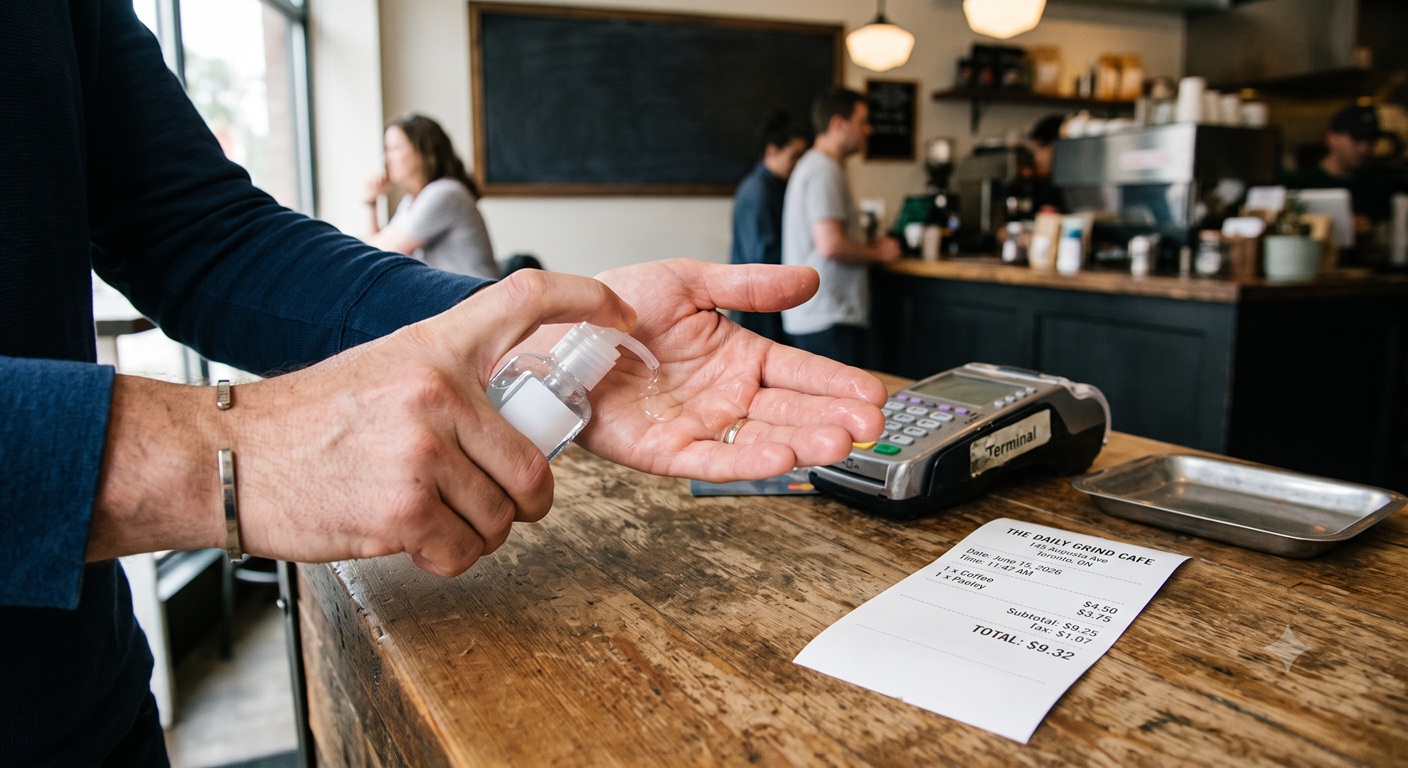
Hand sanitizer amplifies absorption. Research has shown that using ethanol-based hand sanitizer before touching thermal receipt paper can dramatically increase the amount of BPA absorbed through the skin — by as much as 100-fold compared to dry hands. Cashiers who sanitize frequently, as many were trained to do during the COVID-19 pandemic, may be inadvertently increasing their own exposure.
Lotion has the same effect. Any skin-softening product that increases moisture or permeability on the hands — hand cream, moisturizer, barrier cream — can also increase dermal absorption of BPA from thermal paper.
What the Research Links to BPA Exposure in Pregnancy
The science here is still developing, and it's important to be honest about the strength of the evidence. Most human studies show associations — meaning BPA exposure correlates with certain outcomes — rather than proven direct causation. With that caveat clearly stated, the research picture is consistent enough that major health organizations take it seriously.
A 2017 systematic review of 35 studies concluded that BPA exposure during pregnancy is associated with negative impacts on maternal, fetal, and neonatal outcomes, including birth weight, rates of preterm birth, developmental defects, and recurrent miscarriage. The review's authors noted that occupational exposure should be discouraged during pregnancy.
A separate meta-analysis of 7 preterm birth studies found that higher maternal BPA exposure was associated with a 36% increased risk of preterm birth overall — and a 92% increased risk in populations with the highest exposure levels.
Other areas of ongoing research include:
- Miscarriage. BPA has been shown to disrupt progesterone receptor signaling in the uterus, which is critical for maintaining early pregnancy. Some studies link higher BPA blood levels in women to increased rates of recurrent miscarriage.
- Birth weight and fetal growth. Multiple studies have found associations between maternal BPA exposure and lower birth weight or smaller-than-expected fetal size.
- Gestational diabetes. Some research links BPS (the common BPA substitute) to a higher risk of gestational diabetes, with one observational study finding a 68% higher risk in pregnant women with the highest BPS exposure levels.
- Long-term effects in children. Research on prenatal BPA exposure and childhood outcomes — metabolic health, neurodevelopment, hormone function — is ongoing, with animal studies showing effects that researchers are now investigating in human cohorts.
The honest summary: the evidence is not settled enough to assign precise risk numbers to any individual worker, but it's consistent enough that many researchers and health agencies recommend reducing exposure during pregnancy as a reasonable precaution.
BPA-Free Doesn't Mean Safe
This is one of the most important points in this article. Many employers, if they've made any change to their receipt paper at all, have switched to "BPA-free" paper. For a pregnant worker, this is not enough information.
"BPA-free" almost always means the paper uses bisphenol S (BPS) or another bisphenol analog instead. BPS is structurally similar to BPA, interacts with many of the same hormone receptors, and is not meaningfully safer for a developing fetus. The gestational diabetes research cited above, for example, was specifically about BPS — not BPA.
The distinction that matters is phenol-free — paper that uses none of the bisphenol family of chemicals. Technologies like vitamin C-based developers (ascorbic acid), urea-based compounds (Pergafast 201), and Blue4est paper achieve this. If your store uses "BPA-free" paper but not phenol-free paper, you are still being exposed to bisphenols.
You can find more information about the BPA-free vs. phenol-free distinction in our article on the science of bisphenols, and a list of retailers who have made the switch in our 2026 retailer scorecard.
Your Rights as a Pregnant Worker
This is an area where many retail workers don't know what they're entitled to ask for.
The Pregnant Workers Fairness Act (PWFA), which took effect in June 2023, requires employers with 15 or more employees to provide reasonable accommodations for limitations related to pregnancy — including the need to avoid certain chemicals. The EEOC specifically gives the example of an employee who needs to avoid certain chemicals as the type of limitation the PWFA is designed to cover.
Importantly, you do not need a formal medical diagnosis. You need to communicate a limitation to your employer. If your doctor advises you to reduce bisphenol exposure during pregnancy, that is sufficient basis to request an accommodation.
What reasonable accommodations might look like:
- Reassignment to a non-register role (stocking, customer service, fitting rooms) for the duration of pregnancy
- Provision of nitrile gloves for all register work
- Employer switching to phenol-free receipt paper
- Reducing printed receipts by only printing on customer request
- Reassignment to a self-checkout monitoring role where direct receipt handling is minimal
What employers cannot do:
Employers cannot force a reassignment or demote a pregnant worker without the worker's agreement simply because of pregnancy. The process is supposed to be an interactive dialogue — you communicate a need, and the employer works with you to find something feasible. They also cannot retaliate against you for making an accommodation request.
If you're uncertain about your rights, OSHA's reproductive hazards resources and the EEOC's PWFA guidance are both publicly available and written in accessible language.
Practical Steps You Can Take Today
Even before you speak with your employer, there are things you can do to reduce your exposure on your next shift.
1. Keep your hands dry when handling receipts. BPA transfer to skin is dramatically higher with moist or recently sanitized hands. If you sanitize, wait until your hands are fully dry before touching receipt paper. Same goes for lotion. This is one of the simplest and most evidence-backed steps you can take.
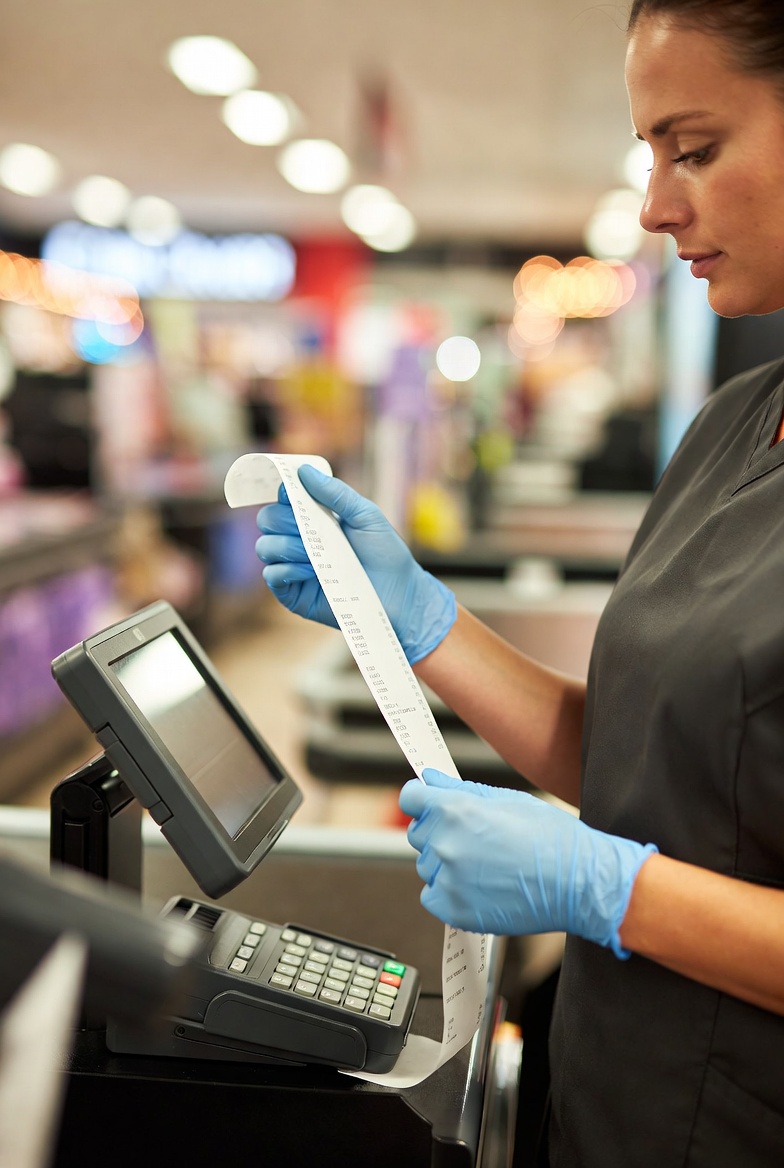
2. Ask about nitrile gloves. Nitrile gloves create an effective physical barrier. One study found that cashiers who wore nitrile gloves while handling receipts for two hours showed no significant increase in BPA levels, while those who handled receipts barehanded had BPA levels that were 3–5 times baseline by the end of the session. These are inexpensive, widely available, and unambiguously effective. See our resources page for options.
3. Wash hands with soap and water before eating or touching your face. BPA absorbed from receipts doesn't just enter through the palms — hand-to-mouth transfer is also a route. Washing with plain soap and water before any food or face contact is a meaningful reduction step.
4. Ask your manager about print settings. Many POS systems can be set to only print a receipt when the customer requests one. If your store's merchant copy receipt is going straight into a drawer anyway, ask whether it needs to be printed at all.
5. Talk to your doctor about your occupational exposure. Your OB or midwife may not know that thermal receipt paper is a bisphenol exposure source — it's not always on their radar. Telling them "I'm a cashier and I handle thermal paper receipts throughout every shift" gives them context they need to give you the best advice for your pregnancy.
6. Know your employer's paper. Ask your manager or the store operations team: is the receipt paper BPA-free? Is it phenol-free? If it's "BPA-free" but not phenol-free, you're still being exposed to bisphenol S. This question is reasonable and documented — it creates a paper trail if you later need to request an accommodation.
A Note on Proportionality
This article is meant to inform, not to alarm. Many people work as cashiers throughout healthy pregnancies. The risk from bisphenol exposure is real but it's part of a broader picture — your diet, sleep, stress levels, prenatal care, and other factors all matter too.
What the evidence supports is this: pregnant cashiers have meaningfully higher bisphenol exposure than the general population, bisphenols are not benign during fetal development, and there are practical, low-cost steps available to reduce that exposure. Taking those steps is sensible. Catastrophizing is not necessary.
The goal is the same as it is for any occupational health question during pregnancy: reduce avoidable exposure, stay informed, and involve your healthcare provider.
For more detail on how bisphenols affect fertility and reproductive health more broadly, see our article on BPA, fertility, and reproduction. For workers in all industries — not just retail — see our guide to who is at risk from thermal paper exposure. If you're a manager or business owner looking at your compliance obligations, our Washington State compliance guide also covers California AB 1604 and the broader regulatory direction.